
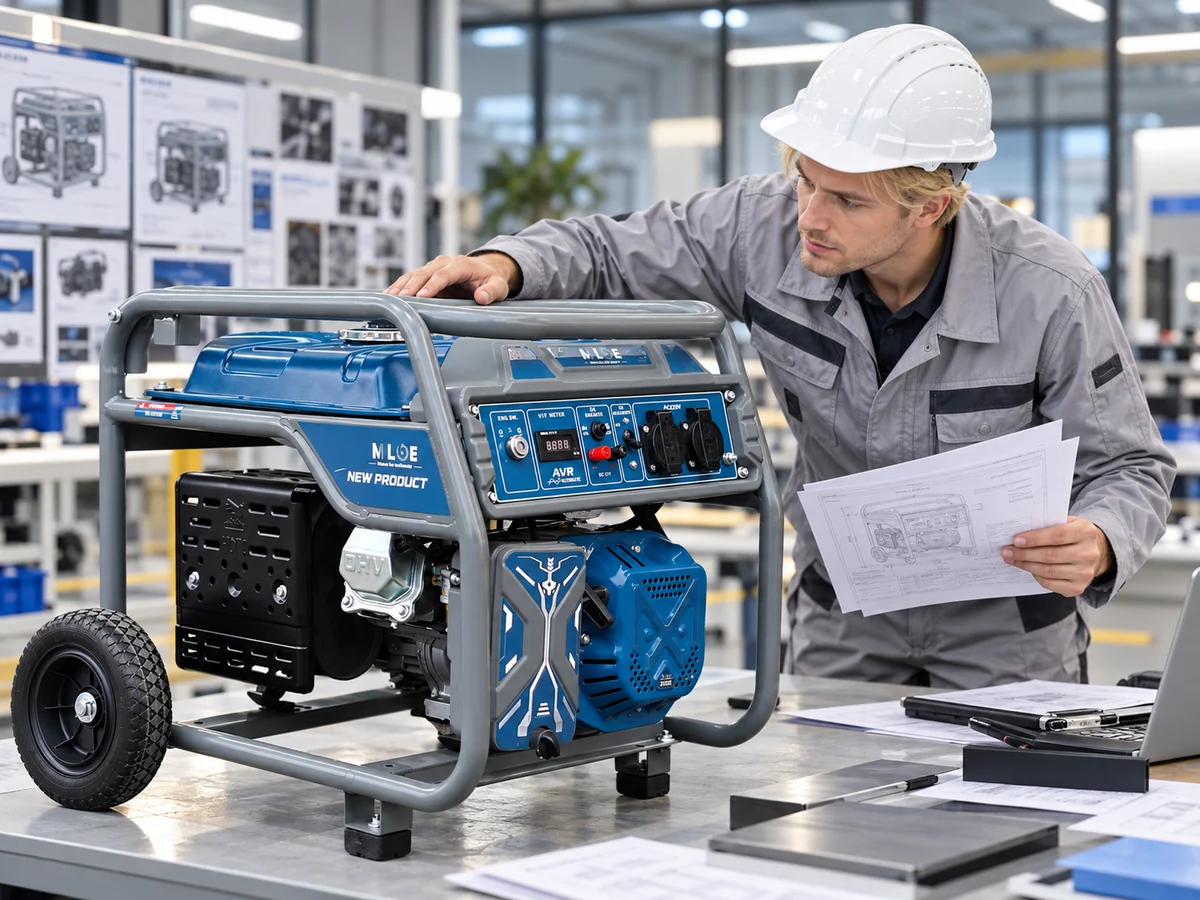
Generator Manufacturer in China: How Importers Can Compare Factories Beyond Price
Importers searching for a generator manufacturer in China are usually presented with hundreds of factories, trading companies and sourcing platforms offering similar-looking products. At first glance, the purchasing decision may appear simple: compare power output, engine size and FOB price, then choose the lowest quotation.
In practice, professional generator buyers know that the cheapest quotation is rarely the only factor that determines whether an order is profitable. For distributors, wholesalers and machinery dealers, generator sourcing should also consider product consistency, spare parts availability, packaging, warranty support, customisation, documentation and the manufacturer’s ability to support repeat orders.
This guide explains how buyers can evaluate a Chinese generator manufacturer from a commercial perspective rather than relying only on price.
1. Confirm Whether You Are Dealing With a Manufacturer or a Trading Company
One of the first questions importers should ask is simple: Who actually manufactures the generator?
Both factories and trading companies can be useful suppliers. The important point is understanding the supply chain. A direct generator manufacturer may offer greater control over production, easier OEM customisation, better access to technical information, faster spare-parts matching and clearer quality-control responsibility.
A trading company may offer broader product variety and mixed-container sourcing, but buyers should still understand which factory is responsible for each model. For long-term generator distribution, transparency is more important than whether the supplier describes itself as a “factory”. Ask for information about production facilities, assembly capability, testing procedures and the origin of important components.
2. Compare Rated Output, Not Just the Largest Number on the Label
Generator marketing can become confusing because suppliers may display rated output, maximum output, peak output or starting output. These numbers are not interchangeable.
For dealers, rated output is usually more useful when comparing models because it indicates the output intended for normal operation. A generator advertised as “5.5 kW maximum” may have a lower continuous rated output.
Importers should therefore request a clear specification sheet showing rated AC output, maximum AC output, voltage, frequency, phase, engine displacement, fuel tank capacity, operating time, alternator specification and starting method. This makes supplier quotations easier to compare on a like-for-like basis.
3. Evaluate the Engine and Alternator Together
A generator is not simply an engine attached to an electrical outlet. Its commercial reliability depends on the complete system, including the petrol or diesel engine, alternator, AVR or inverter module, control panel, circuit protection, frame, fuel tank, wiring, sockets and starting system.
Importers should ask suppliers whether different component configurations are available. A dealer targeting a price-sensitive market may require a different specification from a distributor targeting professional contractors. The correct question is not “What is your cheapest generator?” but “What configuration is appropriate for my target customer and selling price?”
4. Check Whether the Factory Can Support Multiple Generator Categories
A generator importer may begin with one product range but later expand. A supplier capable of supporting multiple generator categories can make future sourcing easier.
Typical categories include open-frame petrol generators, diesel generators, inverter generators, portable generators, electric-start generators, home-backup generators and agricultural-use generators. A broader range can also help distributors build mixed shipments instead of relying on a single SKU.
Buyers can review MLBE’s generator range when comparing different categories and output classes.
5. Ask About OEM and Private-Label Capability
Many importers do not want to sell a supplier’s factory brand. They want to develop their own local brand. When comparing a generator manufacturer in China, ask what level of OEM customisation is available.
Possible options include brand logo, colour, control-panel label, carton design, instruction manual, model number, stickers, packaging, accessories, voltage and socket configuration.
However, customisation should not be treated purely as a design exercise. Every change should be confirmed technically before production. An attractive private-label generator is still a poor product if spare parts, manuals or specifications are inconsistent. For more detail, see MLBE’s OEM petrol generator guide.
6. Inspect the Factory’s Quality-Control Process
A professional generator supplier should be able to explain how units are checked before shipment. Importers may want to ask whether inspections cover starting performance, output voltage, frequency, load testing, fuel leakage, noise, wiring, frame assembly, cosmetic inspection, accessories and packaging.
For larger orders, buyers may also arrange a third-party pre-shipment inspection. The purpose is not to distrust the supplier. It is to establish an objective acceptance standard before the goods are shipped. Clear QC requirements can prevent disputes later.
7. Spare Parts Can Matter More Than a Small Price Difference
A common sourcing mistake is focusing heavily on the first container price while ignoring after-sales support. Generators contain consumable and replaceable components.
Depending on the product and market, dealers may need access to air filters, recoil starters, carburettor parts, AVR units, ignition coils, switches, breakers, fuel caps, sockets, gaskets and starter motors.
Before ordering, ask the factory how spare parts are identified and supplied. A supplier that can support parts over several years may be more valuable than another supplier offering a slightly lower initial price.
8. Review Packaging From a Distributor’s Perspective
Packaging affects far more than appearance. Poor packaging can create transit damage, scratched frames, cracked plastic parts, damaged control panels, missing accessories and increased warranty claims.
Ask how the generator will be packed and whether packaging can be strengthened for long-distance sea freight. Importers should also check carton dimensions, gross weight, units per pallet, units per container and loading method. This information helps calculate landed cost accurately.
9. Compare Total Landed Cost, Not FOB Price Alone
Suppose Supplier A is USD 10 cheaper per generator. That does not necessarily mean Supplier A is cheaper.
The true cost may also include inland freight in China, export packaging, ocean freight, customs duty, port charges, local delivery, inspection fees, damaged units and warranty claims. For serious wholesale buyers, the more useful calculation is total landed cost per saleable unit.
10. Ask About Lead Time Before You Need the Stock
Generator demand is often seasonal. Demand may increase before summer, storm seasons, farming periods, construction activity, power-shortage periods or local promotional campaigns.
Buyers should understand standard production lead time, customised production lead time, peak-season capacity, shipping schedules and repeat-order lead times. Supply reliability can become an important competitive advantage.
11. Check Documentation Early
Do not wait until the container is ready to ask about documents. Depending on the destination country, buyers may require a commercial invoice, packing list, bill of lading, certificate of origin, product test documents, manuals, labels and conformity documentation.
Requirements differ between countries. Importers should confirm applicable regulations with their customs broker, local authorities or certification consultant before placing the order.
12. Evaluate Communication Quality
Supplier communication is often underestimated. During a long-term business relationship, importers may need answers about technical problems, replacement parts, model differences, production status, shipping documents, warranty claims and customisation.
A manufacturer that responds clearly and consistently can reduce operating costs for the importer. Fast quotation alone does not prove good service. Look at how the supplier handles technical questions and problems.
13. Start With a Commercially Sensible Product Mix
A first order does not necessarily need twenty generator models. For many distributors, a more practical strategy is selecting several sizes that cover different price points, such as an entry-level portable generator, a medium-output household or shop model, a higher-output commercial model and an inverter option for customers requiring cleaner power.
This allows the dealer to test market demand before expanding the range. See also MLBE’s 3kW vs 5kW generator guide.
Generator Factory Comparison Table for Importers
| Area | What to Verify | Why It Matters |
|---|---|---|
| Rated output | Rated vs maximum kW | Prevents misleading product comparison |
| Engine | Model, displacement, starting system | Affects serviceability and performance |
| Alternator | Winding, AVR/inverter, protection | Affects electrical performance |
| QC | Starting, load, voltage and packaging checks | Improves batch consistency |
| OEM | Logo, colour, carton, manual, MOQ | Determines private-label flexibility |
| After-sales | Spare parts and warranty process | Supports dealer networks |
| Logistics | Carton size, weight and loading quantity | Affects landed cost |
FAQ
How do I know whether a China generator supplier is a real manufacturer?
Ask for production information, factory photos or video, testing procedures, product documentation and details about where key components are assembled. For larger orders, buyers can also arrange an independent factory or pre-shipment inspection.
Should I choose the lowest-priced generator factory?
Not automatically. Compare total landed cost, specification, warranty exposure, packaging, spare parts and repeat-order consistency rather than only the quoted unit price.
What should I send a generator manufacturer before requesting a quotation?
Provide your target market, required power range, voltage, frequency, starting method, expected quantity, OEM requirements and destination so the supplier can quote a relevant configuration.
Why Importers Work With Chongqing MLBE Mechanical & Equipment Co.,Ltd.
Chongqing MLBE Mechanical & Equipment Co.,Ltd. supplies generators and other small machinery to international distributors and importers. MLBE’s generator range is designed for buyers seeking practical product options for wholesale, distribution and private-label projects.
Importers can discuss generator specifications, mixed product requirements, OEM branding, packaging, spare parts, repeat orders and market-specific configurations. Buyers can also review MLBE’s generator range and catalogue resources before requesting a quotation.
Final Thoughts
Choosing the right generator manufacturer in China should be treated as a supply-chain decision rather than a one-time price comparison.
Importers should evaluate manufacturing transparency, rated performance, engine and alternator configuration, quality control, OEM capability, spare-parts support, packaging, landed cost, production lead time, documentation, communication and long-term supply capability.
A slightly better sourcing decision at the beginning can reduce warranty problems, stock shortages and customer complaints later. For distributors planning their next generator order, the best supplier is usually not simply the factory with the lowest quotation. It is the manufacturer that can help the importer build a reliable and repeatable product range.
Explore MLBE generator models and factory supply
Start with the MLBE petrol, diesel and inverter generator range, and compare published ratings on individual model pages. Review factory and OEM ordering requirements, then check the model manual index and available technical reports. A document only applies to its named model and configuration.