
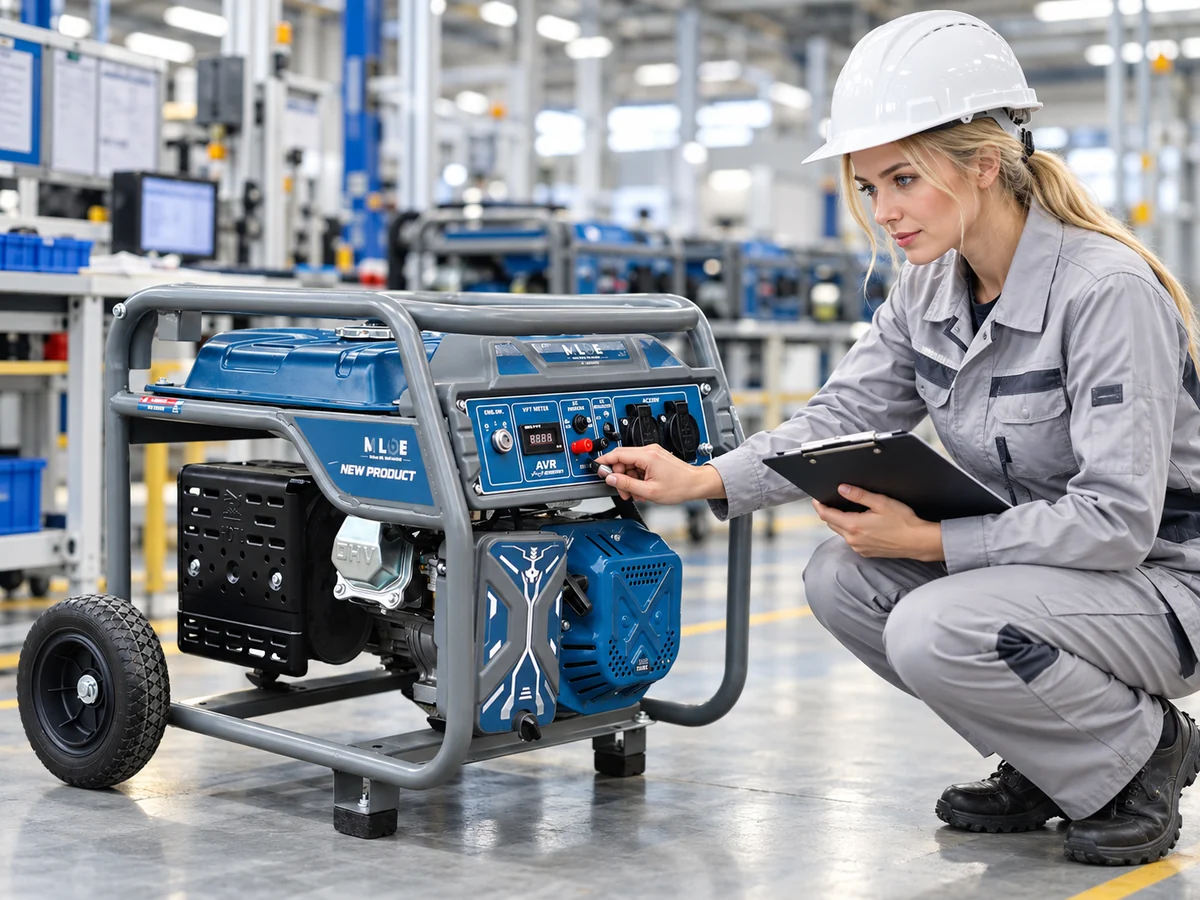
OEM Petrol Generator: What Importers Should Confirm Before Private-Label Production
An OEM petrol generator order lets an importer specify an agreed base model and private-label branding for its own distribution network. The same product may be described as an OEM gasoline generator in an export catalogue. Use one approved specification to keep the fuel description, model identity and supplied configuration consistent.
For a private-label generator project, settle the rated output, electrical setup, service parts and sample approval before finalising logos or carton artwork. Customisation scope, MOQ and lead time must be confirmed for the chosen model. This guide covers the decisions to record before production.
1. Define the Base Generator Specification
Before discussing logo colours or carton design, confirm rated output, maximum output, voltage, frequency, engine, alternator, fuel tank, starter, sockets, breaker, AVR, dimensions and weight.
The approved specification should become the reference for production. This reduces the risk of misunderstandings later.
2. Decide Which Elements Actually Need Customisation
Not every component needs to be changed. Common OEM requests include branding, appearance, packaging and electrical configuration.
Branding may include the logo, model number, stickers and control-panel label. Appearance changes may involve frame colour, tank colour or plastic trim. Packaging may include carton artwork, labels, barcodes and manuals. Electrical changes can involve socket type, voltage or frequency.
Only request customisation that improves market fit. Unnecessary customisation can increase cost, MOQ and lead time.
3. Create a Clear Model-Naming System
Importers sometimes underestimate model numbers. A good naming system makes it easier to manage inventory, manuals, spare parts, warranty, invoices and dealer orders.
Avoid changing model names randomly between shipments. Stable naming makes after-sales support easier for both the importer and the factory.
4. Confirm Branding Ownership
If the generator will carry the importer’s own brand, ensure the trademark can legally be used in the target market. The importer should manage local trademark registration and intellectual-property checks where appropriate.
The factory should receive approved artwork in a usable format and the final artwork should be recorded before production.
5. Approve Artwork Before Production
Check spelling, logo position, colour, model number, voltage label, warning labels, carton information, manual cover and contact information.
A spelling mistake across hundreds of cartons can become expensive. Use written approval rather than informal chat messages.
6. Confirm the Sample
For a significant OEM project, a pre-production sample can help verify the final configuration. Check appearance, output, starting, sockets, control panel, labels, manual and packaging.
Any changes should be documented before mass production.
7. Define What Cannot Be Changed
Some customisation requests may affect safety, cooling, electrical design, certification, tooling or cost. A responsible manufacturer should explain when a requested change is technically unsuitable.
OEM does not mean unlimited modification.
8. Discuss MOQ Early
Customised production usually requires a larger commitment than standard stock. MOQ may depend on colour, carton printing, control-panel changes, special components and logo method.
Importers should ask which changes affect MOQ. For buyers testing a new market, a lower-customisation first order may reduce risk. See MLBE’s generator MOQ guide for more detail.
MLBE OEM ordering terms
MLBE supports OEM supply, and the generator minimum order quantity is 50 units. Send your selected models, quantity for each model, destination market and requirements for colours, artwork, labels and packaging. Confirm the proposed model mix and approved customisation scope in the quotation. See MLBE dealer and OEM supply for the purchasing process.
9. Confirm Spare-Parts Compatibility
Private-label branding should not make spare parts difficult to identify. Maintain a cross-reference between your model number, the factory base model, engine and replacement parts.
This can save significant time later when dealers request service components.
10. Include After-Sales Material
A strong OEM project should also consider a user manual, maintenance guide, troubleshooting information, spare-parts list and exploded diagram where available.
These materials can reduce basic customer-service questions and support local dealer networks.
11. Agree on QC Standards
Before production, define what the factory will check. Examples include appearance, output, voltage, frequency, starting, electrical protection, leakage, accessories and packaging.
For larger orders, buyers may arrange independent inspection.
12. Keep a Golden Sample or Approved Specification
One of the best ways to improve repeat-order consistency is keeping an agreed reference specification. When ordering again, both sides can confirm: same as approved specification unless otherwise stated.
This reduces misunderstandings caused by staff changes or long gaps between orders.
13. Think Beyond the First Container
The real value of an OEM generator program often comes from repeat orders. Before launching a brand, ask whether the manufacturer can supply the same configuration next year, whether spare parts will remain available, whether additional power ranges can use similar branding and whether the range can expand into inverter or diesel generators.
Brand consistency matters to dealers.
14. Choose Base Models for an OEM Gasoline Generator Range
Give each private-label model a clear role and retain a cross-reference to its supplier’s base model. Two starting points in the MLBE range are:
- Small conventional generator: review the ML2500 series portable gasoline generator for an open-frame product range. Confirm the frequency-specific rated output, starting system and transport accessories.
- Compact inverter generator: review the ML2500iS portable inverter generator when the range needs a compact model with a published low-THD specification. Confirm optional outputs and parallel equipment separately.
These are base-model references, not a promise that every requested modification is available. Use the inverter and conventional generator comparison to define the product mix, then confirm the feasible OEM changes in writing.
15. Protect Profit by Controlling Specifications
OEM projects sometimes fail because buyers repeatedly ask for a lower price. Eventually, components are downgraded to meet a target.
A better approach is defining a minimum acceptable specification and negotiating around quantity, packaging, accessories, payment terms and product mix rather than reducing quality blindly.
16. Calculate the Real Cost of OEM Customisation
OEM cost should be separated into the base generator cost and the cost created by customisation. A custom carton, special paint colour, printed manual or unique control-panel label may each affect the final quotation differently.
Ask which changes create one-off setup costs, increase the unit price or affect MOQ. Use the wholesale generator price and landed-cost guide to record those charges separately from the base machine and shipping costs.
17. Confirm Market-Specific Electrical and Compliance Requirements
A private-label generator should be designed for the market where it will actually be sold. Before mass production, verify the required voltage, frequency, socket type, warning labels and any applicable safety, emissions or certification requirements.
Do not assume that a standard export configuration is automatically suitable for every country. The importer should confirm current local requirements with the relevant authority, customs professional or qualified compliance consultant and then provide the confirmed requirements to the manufacturer in writing.
18. Use Change Control for Repeat OEM Orders
One of the biggest risks in private-label sourcing is an undocumented component change between production batches. Even a small change to a carburettor, AVR, switch, socket, control panel or packaging can create problems for spare-parts compatibility and dealer support.
For repeat orders, ask the manufacturer to notify you before changing critical components. Keep a version-controlled specification showing the approved engine, alternator, electrical components, artwork and packaging. This is especially important when several dealers are selling the same private-label product.
19. Plan the Product Launch Before the Container Arrives
An OEM project is commercially stronger when sales preparation happens before shipment. Dealers should have final product photos, specification sheets, manuals, spare-parts references, retail pricing and sales training ready before stock arrives.
This also gives the importer time to prepare product listings, distributor materials and after-sales procedures. For broader sourcing decisions, compare MLBE’s generator manufacturer guide, wholesale generator guide and generator supplier checklist.
OEM Petrol Generator Approval Checklist
| Item | Importer Approval |
|---|---|
| Base generator specification | Rated output, engine, alternator, voltage and frequency confirmed |
| Branding | Logo, model name, labels and colours approved |
| Packaging | Carton artwork, barcode, manual and accessories approved |
| Sample | Pre-production sample or approved reference confirmed |
| Spare parts | Parts list and model cross-reference prepared |
| QC | Inspection and acceptance standard agreed |
| Repeat orders | Critical-component change-control process agreed |
FAQ
What does OEM mean for a petrol generator?
OEM usually means the importer sells a generator under its own brand while the manufacturer produces the agreed technical configuration and applies approved branding, packaging and documentation.
Does OEM always require a high MOQ?
Not always. MOQ depends on the requested customisation. Simple logo or label changes may require less commitment than custom cartons, colours, control panels or unique components.
Should an importer approve a sample before private-label production?
For significant orders or major customisation, a pre-production sample or clearly documented approved specification can reduce risk and create a reference for mass production.
Keep an OEM Change Log
For repeat private-label orders, maintain a simple change log showing what was modified and when. Record changes to the engine, alternator, control panel, sockets, colour, artwork, carton, manual and spare-parts list.
This helps purchasing teams understand whether a new quotation is genuinely for the same product as the previous order. It also gives dealers and service teams a clearer reference when customers ask for replacement parts several months later.
When possible, changes should be approved before production rather than discovered during inspection. A disciplined change-control process is especially valuable when several countries or distributors use the same private-label generator family.
Working With Chongqing MLBE Mechanical & Equipment Co.,Ltd.
Chongqing MLBE Mechanical & Equipment Co.,Ltd. works with international buyers seeking generator and machinery supply solutions, including private-label requirements.
OEM discussions can include model selection, branding, packaging, product mix, accessories, spare parts and market-specific requirements. Importers should communicate the intended market, target price range and expected customer type before finalising the OEM configuration.
Conclusion
A successful OEM petrol generator project is built on documentation and consistency. Before production, importers should confirm the base specification, electrical configuration, logo and model name, colour, packaging, manual, sample, MOQ, spare parts, quality control, lead time and repeat-order consistency.
Private label can create long-term value for distributors, but only when branding is supported by a stable product and reliable supply chain.
Request an OEM Petrol or Gasoline Generator Review
Send the intended sales market, selected base models, quantity per model, branding files, packaging requirements and target delivery date. Include voltage, frequency, socket and after-sales requirements so the team can confirm the available configuration, sample process and commercial terms.
Indian importers can start with the petrol generator supplier page for India. For other destinations, send MLBE your private-label generator requirements with the destination country and port.
Related MLBE Generator Resources
Compare the MLBE generator range, review the ML2500 portable gasoline generator as a representative base model, and use the Generator Supplier Checklist before approving a private-label order. For manuals and after-sales information, visit MLBE Technical Support.