
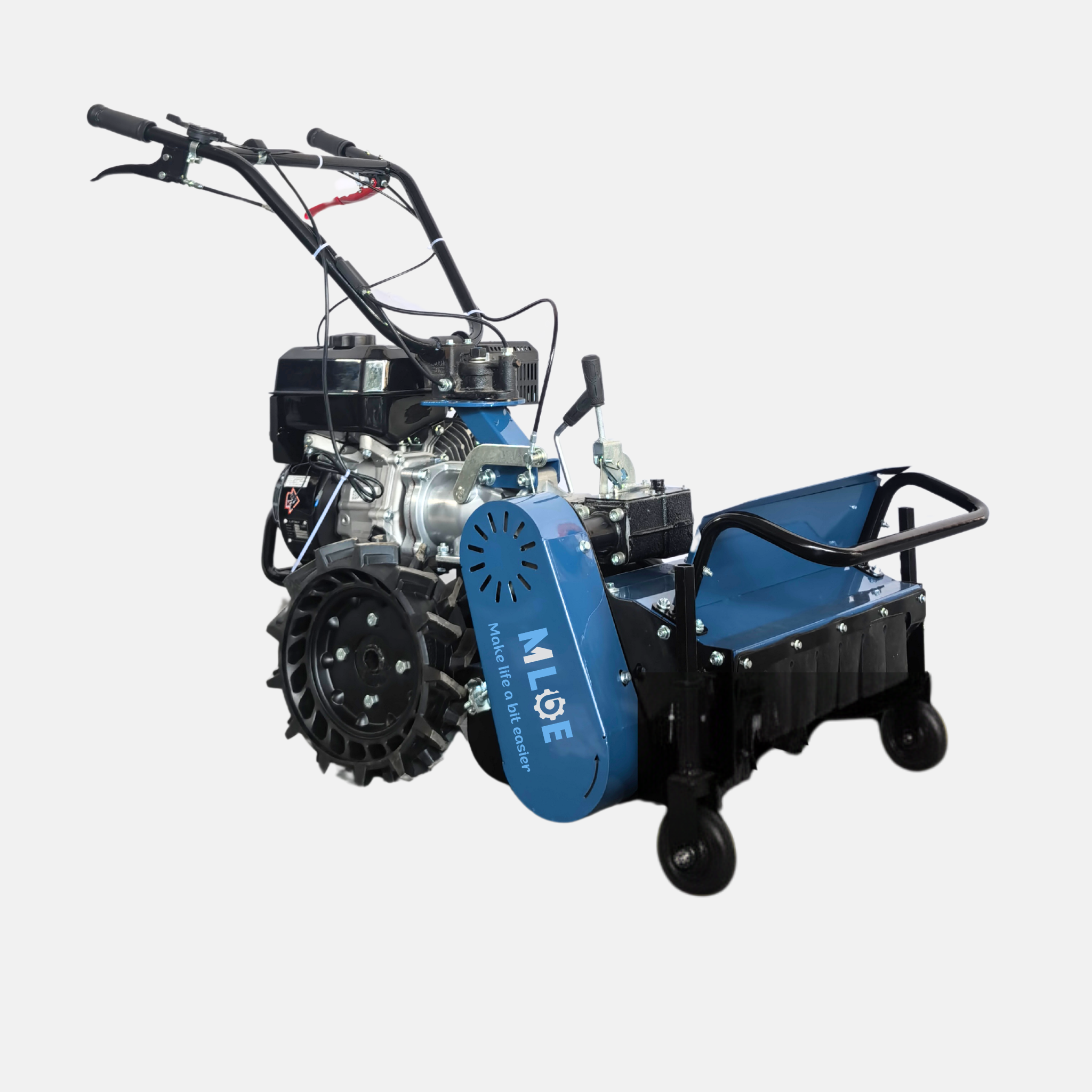
Belt Drive vs Gear Drive Stubble Mowers: Which Setup Fits the Field?
Stubble mowers can look similar at first glance, but transmission design changes how they behave in the field. For dealers and farm-equipment buyers, the practical comparison is often belt drive versus gear drive, then working width, vegetation density, terrain and service requirements.
This article explains how to choose between the two MLBE configurations without treating one system as universally better.

Belt Drive: Simple, Flexible and Easy to Position
The MLBE ML-GC belt-driven series covers several working widths from 450 mm to 800 mm. Belt transmission can be practical for dealers serving users who value a familiar mechanical layout and a range of width options.
The series uses a double-shaft wheeled structure, adjustable handlebars and a multi-shaft cutting device. Because different widths are available within one family, dealers can build a simple step-up range without changing the basic product concept.
Gear Drive: Direct Power Transfer for Repeated Field Work
The MLBE MLGC60-N uses a direct gear-drive system, three forward gears and one reverse gear. Its 600 mm working width and serrated-blade arrangement make it a different proposition from the belt-driven family.
Gear drive is especially relevant when buyers prioritise direct mechanical power transfer and repeated agricultural field use. It can also appeal to dealers serving customers who want multiple travel speeds for changing ground or vegetation conditions.

Which Drive Type Fits Which Situation?
| Field requirement | Belt-drive series | Gear-drive MLGC60-N |
|---|---|---|
| Need several working-width options | Strong fit: 450–800 mm range | Fixed 600 mm platform |
| Dealer wants a simple tiered range | Useful across multiple widths | Better as a dedicated higher-control option |
| Variable travel speed needed | Depends on configuration | 3 forward / 1 reverse gears |
| Direct mechanical transmission preferred | Belt transmission | Gear transmission |
| Dense grass and light crop residue | Suitable when width and engine are matched correctly | Suitable with 600 mm width and serrated blades |
Working Width Should Match the Field, Not Just Productivity Claims
Wider is not automatically better. An 800 mm machine can cover more ground in open areas, but a 450–600 mm machine may be easier to manoeuvre between trees, along field edges or around obstacles.
Dealers should ask customers about row spacing, orchard layout, access width and transport requirements before recommending a wider model.
Vegetation Density Changes the Right Setup
Soft grass, tall weeds and light crop residue place different demands on a cutting system. Buyers should consider vegetation height, stem thickness, moisture and how frequently the area is maintained.
If vegetation is cut regularly, a lighter configuration may be sufficient. If the machine is expected to enter overgrown areas or heavier residue, engine output, blade layout and travel speed become more important.
Terrain and Operator Control Matter
Walk-behind equipment is sensitive to slopes, ruts, soft soil and uneven ground. Compare machine weight, wheel track, handlebar adjustment, reverse capability and working height before deciding which model to stock.
The MLGC60-N lists a working height of approximately 50–80 mm and a 600 mm working width. The belt-driven ML-GC range provides different widths for buyers prioritising access and field coverage.
Service Planning: Belt and Gear Systems Need Different Attention
Belt-driven machines require dealers to keep the correct belt references and monitor tension and wear. Gear-driven machines require attention to gearbox condition, lubrication and gear-related service points.
Neither system eliminates maintenance. The better choice is the one your dealer network can support reliably with the right spare parts and service knowledge.
A Practical Dealer Recommendation Method
- Ask what vegetation will be cut.
- Measure the typical access and row width.
- Decide whether multiple travel speeds are important.
- Check terrain, slopes and manoeuvrability requirements.
- Confirm which maintenance system the dealer can support more easily.
- Match working width to the real field layout.
Stubble Mower Factory-Quotation Checklist
Stubble mower dealers should confirm the intended vegetation, working environment and service needs before choosing a belt-drive or gear-drive version. A transmission type does not by itself establish safe slope limits, cutting capacity or a machine’s ability to handle stones and debris.
| Buyer requirement | Information to confirm |
|---|---|
| Vegetation | Typical stem density, height, moisture and any material the machine is not permitted to cut. |
| Operating area | Field access, obstacles, gradients and required cutting width. |
| Drive system | Approved belts or gears, lubrication needs, guards and replacement parts. |
| Cutting assembly | Blade specifications, inspection method, safe replacement process and supplied protection. |
| Dealer preparation | Manuals, field demonstration, maintenance tools and warranty procedure. |
What to Test Before a Bulk Order
Agree a test or inspection protocol for the exact ML model on representative vegetation and terrain. Record the measured working width, operator feedback, fuel and service conditions where these figures are available. Do not apply one model’s performance figures to another machine with a different drive system or cutter.
For agricultural machinery, MLBE’s standard MOQ is 20 units, subject to configuration and OEM branding. Request the current specification, parts catalogue and destination-market documents before confirming the purchase order.
Explore MLBE Stubble Mowers
Compare the ML-GC belt-driven series with the MLGC60-N gear-driven model. The complete range is grouped under the MLBE Stubble Mower category.
For manuals, service support or model confirmation, use MLBE Technical Support or contact MLBE with vegetation type, field width and expected working conditions.