
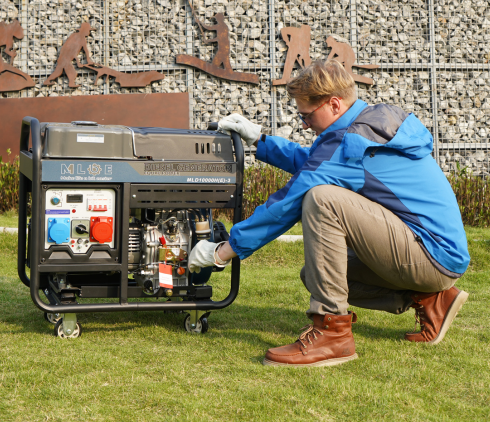
Diesel Engine and Generator Maintenance Guide: Daily, Weekly and Service Intervals
Regular diesel generator maintenance helps reduce unplanned downtime, catch fuel and cooling-system problems early, protect the starting system and keep output more stable over long operating periods. For importers, dealers, facility operators and equipment owners, a written maintenance schedule also makes warranty, spare-parts and service planning easier.
Use the manual for the exact model: this guide explains how to organise maintenance; it does not set a universal service interval. Requirements vary with the engine, cooling system, load and operating conditions. Follow the specified shutdown and isolation procedure, prevent automatic restarting where fitted, and allow hot components to cool before routine inspection. Leave electrical diagnosis, alternator work and major engine repairs to qualified personnel.
Portable generator safety: run portable generators outdoors, well away from doors, windows and vents. Never run one in a house, garage or other enclosed or partly enclosed space. Keep the unit dry and follow the supplied manual for placement and refuelling. Do not connect a generator to building wiring yourself; arrange a compliant connection through a qualified electrician.
Diesel Generator Maintenance Checklist
A useful maintenance plan covers five areas: fluids, filters, starting system, cooling system and electrical output. The simplest way to avoid missed service is to record operating hours and inspect the same items in the same order each time.
| Planning stage | Checks to include where applicable |
|---|---|
| Before each use / daily inspection | Oil and fuel levels, visible leaks, guards, accessible wiring and clear cooling-air paths; check coolant only on liquid-cooled models. |
| Standby inspection and exercise | Use the test frequency, duration and load specified for the model and installation. Review starting-battery condition where fitted, alarms and abnormal operation. |
| Initial service | Enter the exact first-service hour or calendar limit from the model manual; do not assume a universal 50-hour or 60-hour interval. |
| Recurring service | Record the prescribed oil, filter and other service tasks, including applicable hour and calendar limits. |
| Specialist service | Arrange model-specific valve, injection, alternator, electrical and load-testing work when required. |
1. Daily Diesel Generator Maintenance
Check Engine Oil
Check the oil level with the generator stopped and on a stable surface. Low oil can increase wear and overheating risk, while overfilling can also create problems. If the level drops repeatedly, inspect for leaks or abnormal oil consumption rather than simply topping it up.
Check Coolant and the Cooling System
For water-cooled engines, confirm that coolant is at the correct level when the engine is cool. Inspect hoses, clamps, the radiator and the area around the water pump for leakage. Never open a pressurised cooling system while hot.
Inspect Fuel Supply
Confirm there is enough clean diesel for the intended operating period. Check the tank, fuel lines and filter area for leakage. Water or contamination in diesel can cause poor starting, unstable running and injector problems, so drain the fuel-water separator according to the equipment manual.
Inspect the Starting Battery
Look for loose terminals, corrosion, damaged cables and low charge. Standby generators may appear mechanically healthy but fail to start because the battery has gradually discharged. Keep battery terminals clean and follow the battery manufacturer’s maintenance requirements.
Look for Leaks, Loose Parts and Abnormal Vibration
Inspect the generator for oil, coolant and fuel leakage. Check visible fasteners, mounts, belts and guards. New vibration, smoke, unusual noise or a change in exhaust colour can be an early warning that further inspection is needed.
2. Weekly and Standby Generator Checks
A standby generator still needs attention when operating hours are low. Set the inspection and exercise schedule from the model manual and installation requirements. During an authorised test, check the normal operator displays and look for alarms, unusual smoke, noise or vibration. Use qualified personnel for electrical measurements and load testing; do not open live electrical compartments.
Inspect the air-filter condition and clean or replace it only according to the filter type and service instructions. In dusty agricultural or construction environments, intake-system checks may need to be more frequent.
How to Service a Diesel Generator: Practical Routine
- Shut down and isolate the generator. Disconnect loads, follow the equipment shutdown procedure and allow hot components to cool before routine service.
- Record operating hours and recent faults. Note difficult starts, alarms, smoke, vibration, overheating or unstable output before changing parts.
- Inspect for leaks and loose components. Check fuel, oil and coolant areas, mounts, belts, hoses, wiring and accessible fasteners.
- Check engine oil and filters. Service the oil, oil filter, fuel filter and air filter only at the interval and specification required by the model manual.
- Inspect the fitted starting and cooling systems. Follow the manual for battery checks where fitted. Check cooling-air paths on air-cooled engines; check coolant, radiator, hoses and belts only where those components are fitted.
- Run and observe the generator. After service, confirm normal starting, stable speed, no leaks and no warning indicators before applying load.
- Check output under an appropriate load. Where suitable equipment and qualified personnel are available, confirm voltage, frequency and load performance rather than relying only on a no-load test.
- Update the maintenance record. Record the date, operating hours, parts used and any faults that require follow-up.
If the generator still has difficult starting, unstable output, abnormal smoke, overheating or repeated shutdowns after routine service, treat the problem as a diagnostic or repair issue rather than continuing to replace maintenance parts without identifying the cause.
3. Engine Oil and Oil Filter Service
Use the oil-change schedule for the exact engine. Initial-service and recurring-service requirements can differ, and a calendar limit can become due before an operating-hour limit. Record both where the manual specifies them and follow whichever is reached first. Generic 60-hour or 250-hour figures should not be applied to every MLBE engine or generator.
When changing oil, use the grade and specification required for the engine and replace the oil filter when the service schedule calls for it. Record the operating hours, oil specification and date.
Do 250-Hour or 500-Hour Service Intervals Apply to Every Generator?
No. A 250-hour or 500-hour schedule from another engine is not a service schedule for your unit. Confirm each task against the correct manual and operating conditions. Dust, heat or other demanding conditions may require different checks or shorter intervals where the manufacturer specifies them.
| Record for each unit | Information to obtain |
|---|---|
| Model and serial number | Exact engine and generator identification, including the supplied configuration. |
| Initial service | Required tasks, operating-hour limit and calendar limit from the manual. |
| Recurring oil and filter service | Oil specification, quantities, filter references and the interval for each task. |
| Operating conditions | Any adjustments specified for dust, heat, load and duty cycle. |
| Specialist work | Inspection requirements and service-provider responsibilities. |
Dealers planning service stock should confirm filter references, belts, gaskets and other fast-moving parts before shipment. For new procurement, the generator supplier checklist and generator manufacturer selection guide can help structure the technical questions that should be confirmed before a bulk order.
4. Fuel Filter and Fuel-System Maintenance
A restricted or contaminated fuel filter can contribute to difficult starting, power loss and unstable operation. Replace the fuel filter at the manufacturer-specified interval, and inspect for water contamination more frequently where fuel storage conditions are uncertain.
If a diesel generator repeatedly loses prime, stalls under load or shows fuel-delivery symptoms, inspect the tank, hoses, filter, connections and fuel quality before moving to more complex diagnosis.
5. Air Filter Maintenance
Air-filter requirements depend on the element type and operating environment. Dust from fields or unsealed roads can increase servicing needs. Inspect, clean or replace the element as directed by the model manual; a cleaning method suitable for one element may damage another. Do not operate with a damaged or missing element.
6. Cooling-System Maintenance
Air-cooled engines: keep cooling-air inlets, outlets and accessible cooling surfaces clear as directed by the manual. Do not add water or coolant to an air-cooled engine or remove guards to operate it.
Liquid-cooled engines: inspect coolant level, hoses and radiator condition when safe to do so. Follow the specified coolant type, mixture and replacement schedule. Never open a hot pressurised cooling system. Fan and belt checks apply only where those components are fitted.
7. Alternator and Electrical Checks
Before operating the generator, inspect accessible cables and terminals for visible looseness, heat damage or corrosion. Do not work on live conductors. Output instability, repeated breaker trips, unusual alternator noise or burnt smells should be investigated by a qualified technician.
For commercial installations, periodic load testing can help confirm that the generator performs correctly under realistic demand rather than only at idle or no-load conditions.
8. Belts, Mounts and Exhaust System
Where belts are fitted, follow the manual for inspection and tension requirements. Check accessible mounts, exhaust supports and fasteners with the equipment stopped and safe to inspect. Keep guards in place for operation and have exhaust leaks corrected before continued use.
9. Extended Preventive Maintenance
Extended service should follow the manual for the installed engine and generator. Valve-clearance checks, injector or fuel-pump work and electrical testing require model-specific procedures and trained personnel. Turbocharger and radiator tasks apply only to units fitted with those components; an annual date alone does not make every listed task due.
Diesel Generator Troubleshooting Signs That Need Attention
- Difficult starting: check battery charge, fuel supply, filters and starting circuit.
- Unstable speed or frequency: investigate fuel delivery, load conditions and governing system.
- Black smoke: may be associated with excessive load, restricted air intake or combustion problems.
- White or unusual smoke: can indicate fuel, temperature or engine-condition issues that need diagnosis.
- Overheating: stop according to the manual and allow the unit to cool. Have the relevant cooling-air path or liquid-cooling system checked; do not continue running through repeated over-temperature shutdowns.
- Repeated breaker trips: confirm the connected load and have the electrical system checked if the problem continues.
- Oil or coolant leakage: identify and repair the source before continued operation.
Keep a Diesel Generator Maintenance Record
For each unit, record the model and serial number, operating hours, service date, oil and filters used, battery condition, coolant work, faults found and parts replaced. For distributors and fleet operators, this makes recurring issues easier to identify and helps forecast spare-parts demand.
Spare Parts to Plan for
Common service inventory can include oil filters, fuel filters, air filters, belts, hoses, battery-related items and model-specific gaskets or seals. Importers and dealers should confirm the recommended spare-parts list before placing a bulk generator order so routine service is not delayed after delivery.
Diesel Generator Maintenance FAQ
How often should a diesel generator be serviced?
There is no single interval for every generator. Service frequency depends on the engine, operating hours, duty cycle and environment. Use the model manual as the final reference and track operating hours accurately.
How often should generator oil be changed?
Many engines require an early first oil change followed by longer periodic intervals, but the exact number varies by model. Use the specified oil grade and service interval in the engine manual.
Does a standby generator need maintenance if it rarely runs?
Yes. Batteries can discharge, fuel can deteriorate, moisture can accumulate and seals or connections can develop problems even when operating hours are low. Scheduled inspection and test runs remain important.
When should a technician inspect the generator?
Seek qualified support for repeated electrical faults, unstable output, major leaks, overheating, abnormal internal engine noise, injector or fuel-pump work, alternator faults and major engine repairs.
Get Model-Specific Support from MLBE
Chongqing MLBE Mechanical & Equipment Co., Ltd. (MLBE) supplies diesel engines, generators and related agricultural power equipment for international distributors. For model-specific service information, visit MLBE Technical Support or review the product catalogue and user manuals.
Buyers comparing power units can review the MLBE diesel engine range, including the MLD168F diesel engine and larger MLD186FA / MLD188F / MLD192FA series. Generator buyers can compare the diesel generator range and the complete generator category.
For company background and export-market context, see the MLBE company profile. Importers and dealers can also contact MLBE with the model number, operating hours and service requirements to discuss technical information, spare parts or bulk supply.